
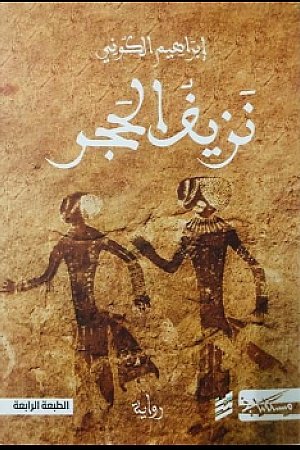
The Bleeding of the Stone
Overview
N/A
Summary
The Bleeding of the Stone marks a groundbreaking achievement in Arab literature, offering a unique and dazzling narrative model. In this novel, Ibrahim Al-Koni tackles themes rooted in traditional desert life: the resilience of the human spirit, and the eternal conflict between good and evil. The novel has gained widespread popularity among readers and garnered attention from international cultural and media institutions. The Guardian listed it as one of the best books about Libya, while Kirkus Reviews praised it as “a successful combination of a tale, a political statement, and a lyrical lament of the past." The novel has been translated into English and German, receiving critical acclaim”.
In The Bleeding of the Stone, myth blends seamlessly with reality as Al-Koni borrows from the story of Abel and Cain, exploring the sin of fratricide. The narrative follows the inner journey of a reclusive goatherd, Asouf, delving into his emotions, his love of isolation, and his coexistence with the harsh desert landscape and its animals. Asouf believes in the power of nature and the animals to aid him in times of danger, as reflected in his words: “Believe your heart… What good is there for the Man of the desert if he loses his heart? He who loses his heart will be lost among men.”
Al-Koni’s journey of inner exploration, however, is not limited to the soul of the protagonist. He ventures into the soul of the desert itself, where everything bleeds—stones, humans, and animals alike. This bleeding, whether in the form of sweat from harsh conditions or actual blood, symbolizes the deadly challenges that permeate desert life.
The French academic Pierre-Louis Raymond reflects on the novel: “The Bleeding of the Stone transports us to a mythical realm, brimming with secrets that embody what could be called the Libyan collective consciousness. It is a narrative in which you will not hear about Benghazi, Tripoli, or Misrata, but instead about places—both real and mythical—barely known to non-Libyans, such as Wadi Mathendous, the Abrhou Plains, or Misak Satfat, the birthplace of Asouf. The novel is a kind of self-soliloquy, highlighting the strong, indescribable bond between Asouf and the Waddan, the ancient and similarly reclusive desert animal. The metaphysical and spiritual dimensions of the novel transcend its mythological aspects, blending spiritual redemption with a primal urge that encourages readers to empathize with Asouf’s human and sub-human characteristics.”
The Bleeding of the Stone is a deeply philosophical novel, rich with symbols and allusions. It raises fundamental questions about space, time, belonging, and the relationship between humans and their environment. It also examines the complex connection between the self and others in this shared environment. This philosophical and mythic dimension is captured by critic Sabri Hafez, who writes: “This beautiful Arabic novel—The Bleeding of the Stone—is full of spiritual momentum and reflections. While the novel, on the surface, appears to depict desert life and human transformations under the relentless tide of modern and materialistic civilization, it is, in fact, a work of deep spiritual obsession. The novel embraces a cosmic perspective where the soul transcends the typical human boundaries to encompass the entire universe, including its plants, animals, and even inanimate objects.”
Why Read This Book
In this book, the reader is promised to enter the mythical realm of the Libyan desert, where s/he will experience the spiritual and existential journey of Asouf and his bond with the desert and its creatures. Throughout the book, Al-Koni raises profound questions about space, time, belonging, and the relationship between humans and their environment..
Key Themes
The Desert Soul
The novel offers a profound exploration of the human spirit, its connection to nature, and the impact of isolation.
A Philosophical Exploration
Al-Koni tackles complex philosophical themes, such as the nature of existence, the meaning of suffering, and the search for redemption.
A Symbolic Narrative
The desert landscape and its inhabitants serve as powerful symbols, representing the cyclical nature of life and death, and the enduring power of the human spirit.
A Critique of Modernity
The novel critiques the destructive impact of modernity on traditional cultures, highlighting the importance of preserving cultural heritage.
Unique Narrative Style
Al-Koni's narrative combines a tale, a political statement, and a lyrical lament, offering a rich and charming reading experience.
Critical Acclaim
Recognized as one of the best books about Libya by The Guardian and praised by Kirkus Reviews, the novel has been translated into multiple languages and received international acclaim.