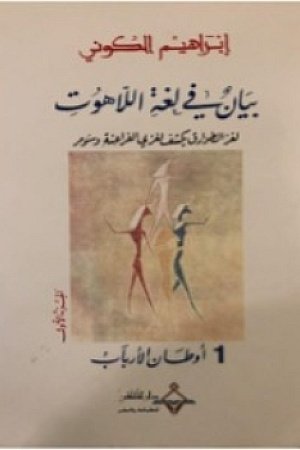
A Manifesto in the Language of Theology: The Mystery of the Tuareg Reveals the Mysteries of the Pharaohs and Sumer
Overview
N/A
Summary
A Manifesto in the Language of Theology: The Mystery of the Tuareg Reveals the Mysteries of the Pharaohs and Sumer is a comprehensive series of seven volumes in which Al-Koni explores the earliest civilizations—the nucleus and cradle of human culture. This series also delves into the ‘mother language’ of both living and extinct languages. Al- Koni investigates how language, in its infantile phase, derived abstract concepts from physical experiences. The volumes in the series are as follows:
The Manifesto Encyclopedia
• Volume I: The Lands of Gods (2001)
• Volume II: The Gods of Lands (2001)
• Volume III: The Gods of Lands (2001)
• Volume IV: A Prelude in the Anthroponomy of the
Primeval Mind (2001)
The Epic of Concepts
• Volume V: The Epic of Concepts: The Tuareg Mystery Reveals the Mysteries of the Pharaohs and Sumer Part 1 (2003)
• Volume VI: The Epic of Concepts: The Tuareg Mystery Reveals the Mysteries of the Pharaohs and Sumer Part 2 (2005)
• Volume VII: The Epic of Concepts: The Tuareg Mystery Reveals the Mysteries of the Pharaohs and Sumer Part 3 (2006)
In volume III: A Manifesto in the Language of Theology: The Mystery of the Tuareg Reveals the Mysteries of the Pharaohs and Sumer (The Lands of Gods, Manifesto Encyclopedia), Al-Koni scans the depths of Tuareg tribal knowledge through a comparative study that examines the hidden connections between ancient Egyptian and Tuareg languages. He posits that the Tuareg mystery unravels the enigmas of the Pharaohs and Sumer. In the introduction, he notes: “No one knows the origin of 'Amahag' or 'Imohag,' but it is likely derived from 'Tamho,' a term found in ancient Egyptian texts referring to the Libyan tribes dispersed in the southern desert of Libya.
The pronunciation of 'Tamho' is not different from 'Tamahaq,' particularly considering that the Tuareg language, written in the 'Tifinagh' alphabet, lacks vowels, much like the neighboring Egyptian language”. Al-Koni further argues that the relationship between these languages is not merely one of mutual influence of neighboring nations or the intermingling of human races. Instead, it is the relationship of a single language, one part of which perished in the Nile Valley due to millennia of internal cultural interactions, while the other survived, preserved by its isolation in the vast expanse of the Great Desert.
In volumes V-VI-VII of The Epic of Concepts: The Tuareg Mystery Reveals the Mysteries of the Pharaohs and Sumer, Al-Koni opens with the assertion that “Language is not a fixed law set by scholars or lexicographers, but the result of work, need, relationship, joy, passion, and the experiences of previous generations who shared an intimate bond with Mother Earth”. Al-Koni navigates the complex terrain of linguistic philosophy, exploring the origins of letters, pronunciation, and their relationship to the philosophy of existence. He discusses the early letter ‘Zay’, which has a counterpart, ‘Ceen’, that is similar in pronunciation but different in meaning. Al-Koni suggests that while ‘Ceen’ has traveled through various world languages, conveying essential or hidden meanings from the language of Genesis, ‘Zay’, with its semantic load, has chosen to remain on the surface.
On the topic of vocabulary, Al-Koni addresses the historical and theological intersections of the word ‘sin’. He observes: “The English term 'sin' has a primitive counterpart in the Tuareg and ancient Egyptian languages, where it means 'two’, a dangerous religious concept implying a duality, and from the dawn of history duality is rejected. The last revealed religion, Islam, condemns it as 'polytheism,' an abomination, the work of Satan, and equivalent to infidelity. Pythagorean teachings, too, rejected duality, favoring odd numbers over even ones, aligning with the concept of monotheism as the foundation of Deism. The primitive language expressed the same rejection through a primitive word that conveys the duality and it's seen in the Latin 'duo' or 'duae’, both of which denote the number two. As mentioned above, in the Tuareg language, ‘ceen’ literally means 'two’, and in English it means 'sin’.”
Former Algerian Minister of Culture Ezzedine Mihoubi has praised this work, stating: “Al- Koni not only defends the Tuareg nation but also honors it in his literature and philosophy. In undertaking these two encyclopedias—'The Epic of Concepts' and 'A Manifesto in the Language of Theology'—he has created a unique universe for the Tuareg, their history, and identity, without isolating them from the broader historical context of neighboring civilizations, especially the Pharaonic and Sumerian. His deep, systematic approach, free from populism, seeks to unravel the civilizational bonds between these intersecting cultures, without undermining their distinct cultural experiences, values, and texts.”
Al-Koni believes that if this series were translated into major world languages, it would spark a profound revolution in understanding. However, he emphasizes that the translator must be skillful not only in the languages but also in philosophy, so the full depth of the work is captured.
Why Read This Book
This book is a fascinating journey through the origins and evolution of language, exploring the deep connections between ancient civilizations. It delves into the rich history and culture of the Tuareg people, gaining a unique perspective on their influence on ancient societies. Al-Koni's groundbreaking work challenges readers to think critically about the nature of language and its impact on human thought and culture. This thought-provoking exploration offers a fresh perspective on the linguistic and philosophical foundations of our world.
Key Themes
The Origins of Language
Al-Koni proposes that these ancient languages share a common root, suggesting a shared linguistic heritage. He explores the development of language from its earliest forms to the complex systems of modern languages.
The Power of Language
The series examines the role of language in shaping human thought, culture, and identity. Al- Koni argues that language is not merely a tool for communication, but a powerful force that can shape our understanding of the world.
The Tuareg Connection
Al-Koni highlights the significance of the Tuareg language and culture, suggesting that they hold key insights into the origins of human civilization. By exploring the Tuareg language, he sheds new light on the ancient world.