
A Bomb for Personal Use
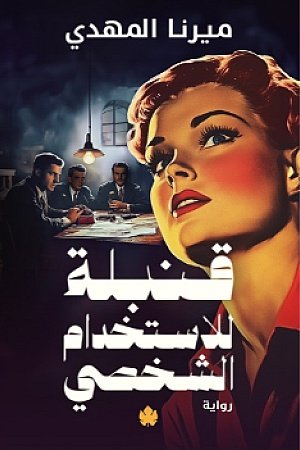
Overview
“There is no good or evil in this world, only brute force that makes you a master and turns others into your slaves. Look at human greed after the war—we have become ravenous serpents ready to devour each other until we swallow the entire universe and perish.”
Summary
Mirna Al-Mahdi's A Bomb for Personal Use marks a deliberate departure from her established reputation in mystery and crime fiction, venturing instead into the complex genre of the espionage thriller. This stylistic shift is not merely a change of subject matter but a sophisticated fusion of the suspenseful plot with profound historical consciousness, compelling the reader to confront the tragic continuum of Palestine, from the Nakba in 1948 to the contemporary political landscape shaped by World War II.
Originally intended as a narrative on the Armenian Operation Nemesis, but the author's focus was fundamentally reoriented by the events of October 7th, 2023. This change led to an intensive and immersive research period. Through extensive study of Palestinian politics, economics, and folklore, and by engaging directly with the lived experiences of its people and its literary heritage—particularly the works of Ghassan Kanafani, Ibrahim Nasrallah, and Radwa Ashour—Al-Mahdi’s narrative emerges not as a dry historical document but as a vibrant, living text imbued with genuine passion.
The plot unfolds as a meticulously constructed network of interconnected events and is characterized by a multi-generational cast. The protagonist, Elias, serves as a symbolic figure of a resistance generation that relied on schemes and subterfuge to trick the colonizers. He is countered by the agent, Aba, whose history is intertwined with his since the Nakba. This central dynamic is supported by a constellation of characters like Milad, Fatima, and Ayub who collectively embody a spectrum of the Palestinian experience: the youthful resistance, the woman burdened with the legacy of loss, and the elder who is the repository of collective memory. The narrative fluidly shifts from tangible, everyday settings like the streets of Jerusalem to a more abstract, existential space where individuals are caught between literal and metaphorical bombs, navigating the complex interplay of fear and liberation, betrayal and hope.
The novel is defined by its masterful fusion of stark realism and nuanced symbolism. Al-Mahdi's prose is a testament to her ability to anchor the narrative in sensory details: the flavors of food, the texture of fabrics, the rhythm of songs—thereby affirming Palestine as a living, cultural entity rather than a mere site of conflict. These symbolic elements are woven throughout the text; trees are signifiers of deep-rooted heritage and resilience, while songs by Fairuz or Mohamed Fawzi act as a lyrical thread, connecting characters to a shared history and transforming music into a form of resistance itself.
The novel’s narrative technique is distinguished by its use of polyphony, a deliberate multiplicity of voices and perspectives. The reader is not confined to the viewpoint of the Palestinian resistance but is granted access to a dialogue of histories, hearing from Jewish survivors of Nazi camps, Armenian survivors of the massacres, and Egyptians and Iraqis living under the British colonialism. This broad narrative scope elevates the conflict from a localized event to a universal human tragedy, inviting a deeper, more empathetic understanding of the impact of war.
The novel literarily intersects with the legacy of resistant Palestinian literature, where the spirit of Ghassan Kanafani is present in the idea of the bomb as a symbolic act of resistance, and Ibrahim Nasrallah in the restoration of collective memory as part of an extended narrative project. The influence of Radwa Ashour is also evident in the deep human sensibility that gives the Palestinian cause an emotional dimension. At the same time, Mirna Al-Mahdi evokes the traditions of Western spy literature - John le Carré, for example - through psychological manipulation and complex character entanglement, but with a local specificity that makes Palestine the authentic stage for events.
Ultimately, the novel's power lies not only in its intricate plot and authentic characters but in its profound capacity to render Palestine a living, resonant cause for its readership, especially for younger generations. It transcends the mere recounting of events; it actively engages the mind and imagination, positioning literature itself as a potent form of resistance. The novel's central thesis is that the true "bomb" is not a physical device but the collective memory that, in its persistence, continually confronts the occupier and reaffirms the inalienable rights of a land's people.
Why Read This Book
This is a unique literary work that combines elements of a spy thriller with historical documentation. It offers an exciting plot while also exploring the human tragedy of war through multiple voices, presenting literature as a form of resistance. The narrative highlights the details of daily life and Palestinian culture, demonstrating that this is a living cause rather than just a sequence of historical events.
Key Themes
Fusion of espionage and history
The novel skillfully merges the suspense of spy fiction with the documentation of Palestinian history since the Nakba.
The Palestinian cause from a human perspective
Beyond political events, the novel addresses the issue through diverse human angles, highlighting stories of characters across generations and backgrounds.
Literature as resistance
The novel emphasizes that literature is not mere imagination but an act of resistance, preserving collective memory and re-presenting the Palestinian cause as alive and enduring.